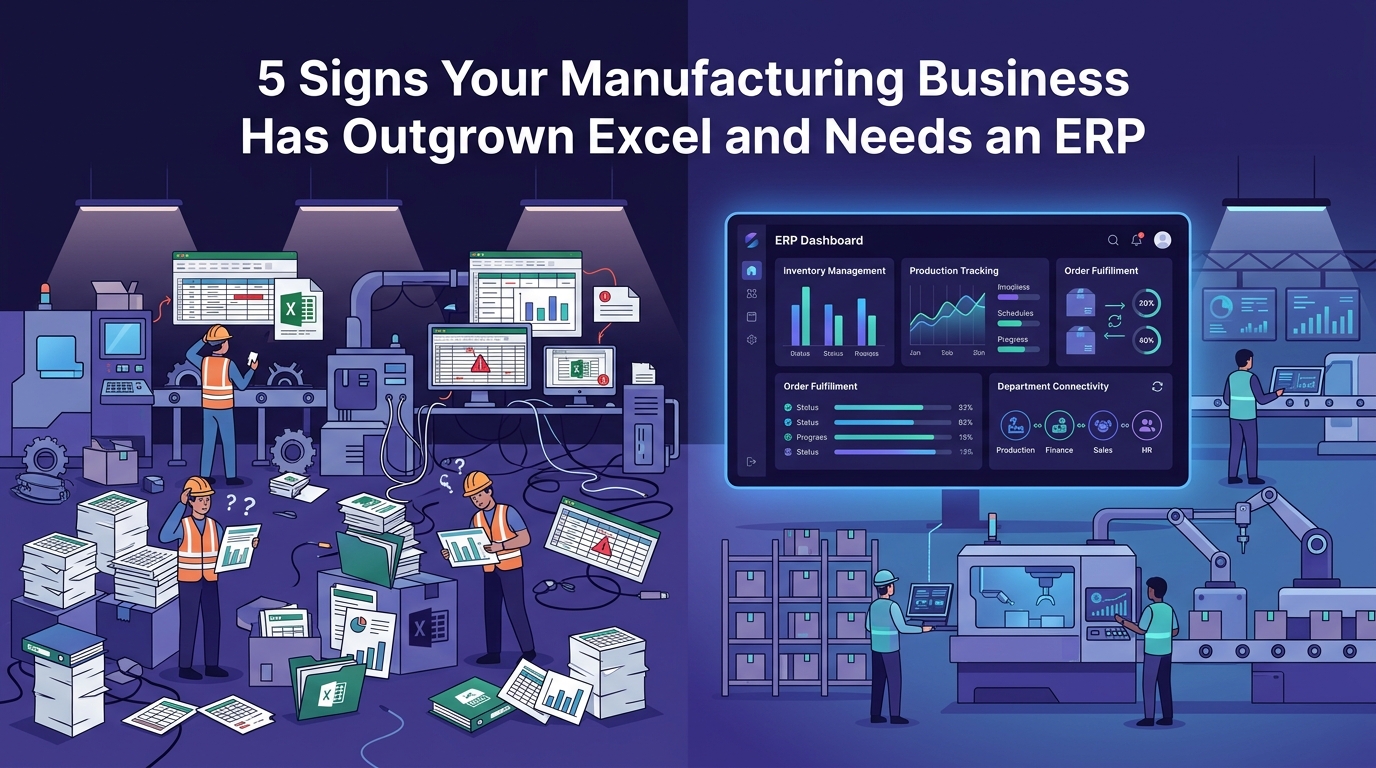
Spreadsheets Got You Here — But Can They Take You Further?
Microsoft Excel is arguably the most powerful general-purpose business tool ever created. For early-stage manufacturers and small production units, spreadsheets are accessible, flexible, and virtually free. They track raw material purchases, log daily attendance, tally batch runs, and generate basic invoices.
However, as your production volume increases, order counts climb, and your factory workforce expands, Excel reaches a breaking point. What was once an asset quietly turns into an operational bottleneck. Recognizing the inflection point where spreadsheets start costing you more in errors, lost time, and delayed shipments than an Enterprise Resource Planning (ERP) system would is essential for sustainable growth.
Sign 1: Version Control Chaos & "final_v3_ACTUAL.xlsx"
When multiple managers across purchase, store room, and floor supervision update stock numbers on separate spreadsheets or shared network drives, version conflict is inevitable. Formulas get overwritten, columns are accidentally deleted, and nobody knows which sheet reflects the actual ground reality. The moment your team spends meeting time arguing over whose file is current, your data integrity has failed.
Sign 2: Inaccurate Inventory and Zero Real-Time Visibility
In manufacturing, batch updates are the enemy of precision. If inventory logs are updated at the end of the day or weekly, supervisors commit to customer orders based on phantom stock. You discover you’re out of essential packing materials or specialized fasteners only after the machine line has been set up—causing costly idle time and rushed, expensive vendor shipments.
Sign 3: Siloed Departments and Redundant Manual Data Entry
Does your sales team enter an order into their sheet, which the production manager then re-types into the floor schedule, which the store keeper copies into a delivery challan, which the accounts team manually re-enters into Tally? Every manual touchpoint multiplies human error rates and wastes hundreds of productive engineering hours each month.
Sign 4: Management Reporting Takes Days Instead of Seconds
When leadership asks basic operational questions—"What was our exact scrap rate on line 2 last month?" or "Which product line gave us the highest gross margin after raw material price fluctuations?"—the answer shouldn't take three days of copy-pasting numbers from six different workbooks. If executive decisions are delayed because data compilation is cumbersome, your business is flying blind.
Sign 5: Zero Audit Trails and Lack of Accountability
Spreadsheets offer no built-in accountability. If a bill of materials (BOM) ratio is altered or an approved vendor rate is modified, there is no timestamped audit log of who changed what, why, or when. During ISO audits, financial reviews, or customer quality disputes, the inability to trace batch numbers back to specific raw material lots creates serious liability.
What a Custom ERP Actually Fixes
A tailored ERP system replaces fragmented files with a unified, single source of truth across your entire operation:
- Connected Workflows: Sales orders automatically trigger material checks, work orders, and procurement requests without manual re-entry.
- Live Production Tracking: Machine operators update work-in-progress (WIP) on rugged tablets, giving supervisors instant floor visibility.
- Automated Stock Alerts: Receive proactive alerts when critical raw materials breach reorder thresholds.
- Role-Based Access: Every employee sees only what they need, with full audit history for every action.
Overcoming the "Isn't ERP Only for Big Enterprises?" Myth
Many manufacturers avoid exploring ERP systems because they equate ERP with massive, multi-crore implementations like SAP or Oracle that take a year to deploy and require dedicated IT departments. But modern software engineering has shifted toward modular, custom-built ERPs. A custom ERP gives small and medium enterprises exactly the modules they need—without bloated license fees, unnecessary complexity, or rigid corporate workflows.
Conclusion: Modernize Your Factory Operations
Outgrowing spreadsheets is a milestone of business success, not a failure. It signifies that your manufacturing unit has reached a scale demanding operational discipline. At VRND Business Solutions, we design and build right-sized, custom ERP software specifically engineered for Indian manufacturing workflows. We help you eliminate floor bottlenecks, safeguard margins, and scale production seamlessly.