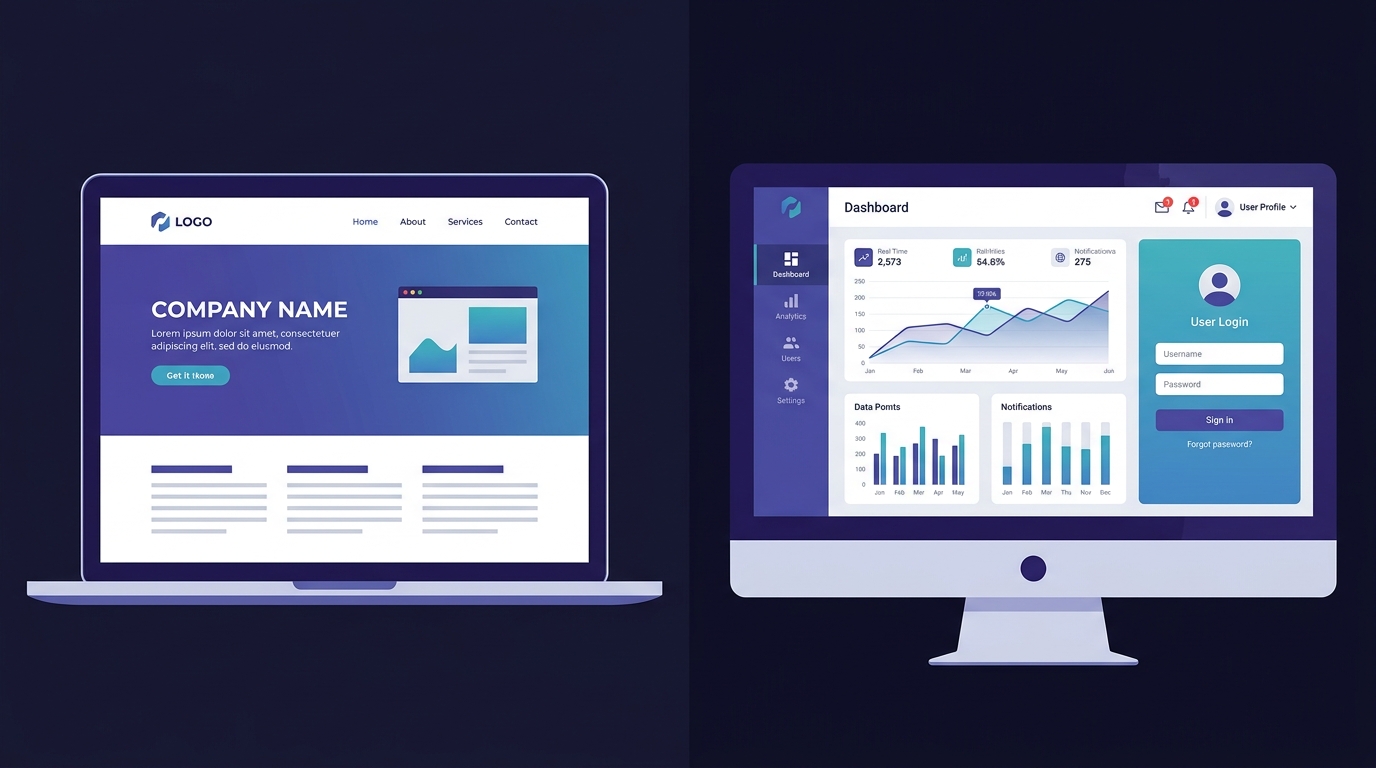
The Confusion: Website vs. Web App
When business owners set out to establish or revamp their digital presence, the terminology can quickly get muddy. You’ll hear terms like "static website," "dynamic web app," "single-page application," and "custom portal" thrown around by designers and developers alike. Often, the two terms—website and web application—are used interchangeably. But conflating the two is one of the most common reasons companies either overspend on unnecessary engineering complexity or underinvest in a basic site that fails within six months.
Choosing the wrong architecture isn't just a technical mistake; it directly impacts your budget, development timeline, maintenance overhead, and scalability. In this guide, we break down the practical differences so you can make an informed investment for your business.
What Exactly Is a Static Website?
In simple terms, a static website delivers pre-rendered content to visitors. Every user who navigates to a URL sees the exact same information, layout, and media unless an administrator updates the code or publishes new content. While modern static websites frequently use JavaScript for smooth animations, mobile menus, and interactive forms, they do not manage individual user state, authentication, or live server-side data manipulation.
Core Characteristics:
- Fixed pages served directly from a Content Delivery Network (CDN) or web server
- No individual user accounts, logins, or personalized dashboards
- Extremely fast page load speeds and superior Core Web Vitals performance
- Minimal maintenance and near-zero server infrastructure security risks
Typical Use Cases: Corporate brochure websites, consulting firm portfolios, local service business sites (such as dental clinics, law offices, and architecture studios), restaurant menu pages, and product landing pages.
What Is a Web Application?
A web application (web app) is an interactive software program accessed through a browser. Unlike a brochure site, a web app processes data, manages distinct user sessions, performs server-side computations, and updates content dynamically in real time based on user inputs and permissions.
Core Characteristics:
- Secure user authentication, role-based access control, and profiles
- Real-time database integration (fetching, storing, and updating user data)
- Complex workflows, calculations, search filters, and transaction processing
- Requires ongoing database management, backend APIs, and server security monitoring
Typical Use Cases: Customer relationship management (CRM) portals, SaaS platforms, e-commerce storefronts with user carts and inventory tracking, client booking and appointment engines, learning management systems (LMS), and employee operational dashboards.
Side-by-Side Comparison
| Feature | Static Website | Web Application |
|---|---|---|
| Typical Cost | Lower upfront; minimal running cost | Higher upfront; ongoing hosting & maintenance |
| Build Time | 1 to 3 weeks | 4 to 12+ weeks |
| Hosting Complexity | Simple CDN / Static server | Databases, cloud servers, API microservices |
| SEO Performance | Exceptional out-of-the-box | Requires SSR/SSG setup for public pages |
| User Interactivity | Informational, contact forms, click-to-chat | Full CRUD (Create, Read, Update, Delete) |
Decision Checklist: Which One Do You Actually Need?
To identify the right choice for your current stage of business, run through these quick questions:
- Do your users need to log in to access personalized data or member-only features?
If Yes → Web Application. If No → Static Website. - Is your primary objective brand awareness, lead generation, and explaining services?
If Yes → Static Website. - Do you need real-time data sync (e.g., live stock tracking, booking slots, ticket statuses)?
If Yes → Web Application. - Will content change weekly or monthly through simple marketing updates?
If Yes → Static Website with or without a headless CMS. - Are you processing recurring subscriptions, custom customer inputs, or multi-step checkout workflows?
If Yes → Web Application.
Real-World Scenarios
Consider a retail brand showcasing handcrafted goods and their showroom location. They primarily need high-resolution product photography, brand storytelling, contact forms, and Google Map integration. A high-performance static website delivers instant load times, perfect SEO, and zero server maintenance.
On the flip side, an industrial equipment supplier that wants customers to log in, view tier-based pricing, request automated quotes, and track shipment statuses needs a custom web application connected to their backend inventory.
Conclusion: Choosing the Right Foundation
Building software you don't need burns cash; building a brochure site when your customers expect self-service creates friction. At VRND Business Solutions, we engineer both high-converting static websites and scalable custom web applications. We help you map out your exact operational goals before writing a single line of code so your digital asset delivers measurable return from day one.